
Dealer Programs: There Might Be a Better Way
A quick note before you read: I listen to the Jefferson Fisher Podcast. He's a lawyer in Texas and in one of his episodes he talked about setting expectations for hard conversations. This is one of those hard conversations.
This isn't a vendor takedown. This isn't a retailer victim story. It's about an industry opportunity. This is also hard work at the retailer, rep and vendor level.
Some of you retailers are executing well within current programs. Some of you vendors are building programs that actually support retailers. If that's you, you might not need this. But if you're frustrated—if margins keep shrinking, if you're giving away value, if the deck feels stacked—there's a better path. And retailers can create it.
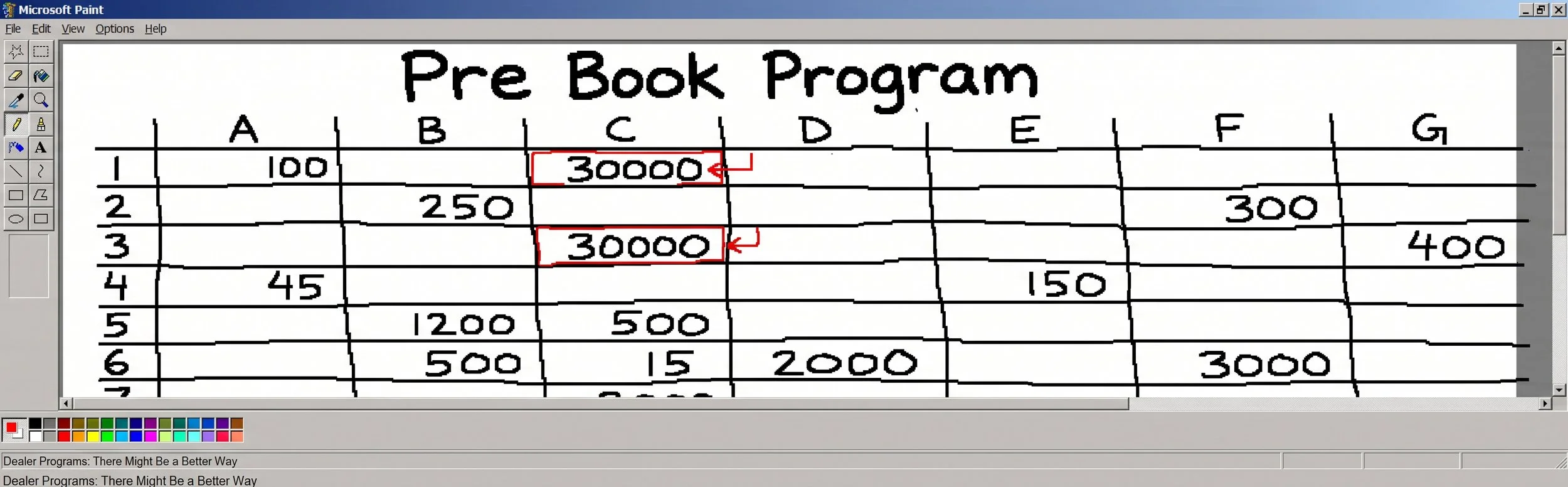
Years ago I was at Giant Link at Deer Valley in Utah. The riding was great. The bikes were awesome. The seminars were packed. One stood out.
A guy named Allen Needle was presenting for Giant. He was there to show Giant retailers how to win. Someone at Giant told him he couldn't use spreadsheets anymore. No screenshots of Excel files. So Allen did what any smart presenter would do: he drew pictures of Excel in MS Paint.
It was hilarious. And brilliant.
Here's what he said: "If Giant isn't your primary brand, it should be. Here's the data proving why."
Then he showed retailers exactly how much additional profit they'd make by switching their primary vendor to Giant. The number was real. The math was sound. By the end of the year, a mid-sized retailer would have enough profit to buy a Mini Cooper. Thirty grand.
He wasn't selling Giant. He was selling the retailer's profit. Giant understood that if their dealers won, they won. He made their bank account the hero of the story.
That was 15-plus years ago.
Today's programs look different. But most are built on old logic: vendors push allocations, retailers hope to move them. That dynamic hasn't changed.
The Problem: Promises Without Proof
Today's dealer agreements are full of promises. But look at the actual language.
"Shall promote [brand] bicycles and related products to maximize demand of the products."
That's it. No definition of what "promote" means. No metric on what "maximize demand" looks like. No consequence if it doesn't happen. A vendor could do nothing and technically be in compliance.
Here's another favorite: "Shall provide DEALER with local market support as provided to other dealers in the same geographical area."
Translation: We'll do whatever we do for everyone else. That's circular logic. If they do nothing for everyone else, they'll do nothing for you.
A retailer signs a $100k pre-book commitment based on these vague assertions about support that might materialize, might not. The vendor celebrates the $100k order. Everyone shakes hands. Six months later, the retailer's stuck with inventory that didn't move and a vendor who was supposed to promote locally but never showed.
That's the trap.
Then there are the incentives that sound good on paper. "Free freight on orders of 10 bikes or more." But what if they don't have the bikes you need? They have bikes scheduled to arrive for pre-program ordering, but will your hot movers be in stock at the beginning of the season? Available for reorder when you need to replenish?
How many times have you created a floor plan with models X, Y, and Z, but had to pivot to X2, Y2, and Z2 because the original lineup wasn't available? That might not throw off your senior sales people, but what about your part-timers? What about your customers looking for a specific bike they saw in your marketing that is no longer available in their size?
One vendor has created scorecards to qualify retailers for better terms or rebates. On the surface, that sounds fair. Let's measure performance.
Except a 1-10 score might depend on how the rep feels that day. Whether the shop is spotless during the visit. Whether the product is displayed exactly how the rep imagines it. Subjectivity masquerading as standards. But you may never really know what you scored or why.
A published rubric should be objective. Measurable. Predictable. But when a score depends on a rep's mood or interpretation, it's not a standard. It's a political game. Retailers spend energy managing perceptions instead of selling bikes.
Here's the real problem: Your margin is connected to your scorecard score. You hit a 9? Better terms. You hit a 7? Worse terms. But you never really know what you scored or why. You can't predict your actual cost. You can't predict your actual margin. How do you plan your business around that? You can't.
That's broken. But here's the thing: it doesn't have to stay broken.
The Hidden Cost: Retailers Are Subsidizing Vendors
Not only is there a risk of your pre-book not meshing well with your business, you are also providing a ton of unpaid labor that vendors depend on.
You're handling marketing for your business and for the brands you carry. You're handling all assembly. You're providing warranty service after the sale. Education. Tools. Replacement parts for bikes that came spec'd poorly. You're tying up cash and space solving vendor problems.
Some retailers do this and excel. Others get squeezed from every direction.
We all know of that one or two models that just get a bad spec and they require a hands-on solution. Sometimes it's parts that you stock. Sometimes it's a lot of labor that is uncompensated. Sometimes it's missed opportunities. And in the worst case scenarios, it's all of these. That's retailer time. Retailer parts. Retailer cash. Retailer space. All to fix a vendor's product design failure.
And while you're doing all that work, your margins are shrinking. Some vendors are taking away your opportunities to generate revenue. You're getting squeezed from above and expected to absorb problems from below.
This practice dates back to the 90s. Margins were better back then. But today vendors are mandating that retailers assemble bikes. Some are insisting they offer professional assembly. If they're mandating assembly, there needs to be standards AND compensation. Don't let them extract your labor while they squeeze your margin. You're running a business. Assembly has value. Demand that they let you charge for setup and assembly. Or demand that they remove it from their website or increase those margins. If they can't increase the margins, increase the MSRP.
And then there's the territorial restriction issue.
Some vendors let authorized online retailers sell into any territory nationwide. But that same vendor won't let you—the retailer down the street who's actually committed to their brand—ship a bike to a customer that moved 100 miles away. This is a huge disconnect and a lot of friction in the final mile of delivery. Why increase that friction?
Think about what that looks like from Julie's perspective. Julie wants a new mountain bike. She has three favorite local bike shops she's worked with over the years as she's moved around. But the vendor won't let any of them ship to her. So Julie goes to the big box retailer. The one that won't remember her name. The one that doesn't know the difference between a hardtail and a full suspension. The one that ships the bike in a box with a wrench and an instruction video. Again, more friction.
Some vendors default to: "We have to protect other retailers in Julie's territory."
But vendors should be more worried about brand equity than protecting territories. Retailers end up doing all the marketing anyway. This is a sure fire way to get that customer that just moved to your territory. Market to them. Just because you have a brand doesn't mean they will come in your front door.
If you have a retailer who's willing to commit to your brand—list them on the dealer locator, let them sell, let them ship. Let them promote your brand across the entire country. Commit to them yourselves too. Yes, you're going to upset a few retailers who didn't put in the work. Good. They have a responsibility to market your brand too.
Meanwhile, make sure your dealer data is clean. Optimize your SEO so customers can actually find your authorized retailers. If your online presence makes it hard for customers to discover the good shops, that's on you, not the retailer.
Here's the question you should ask about every promise or expectation in a dealer agreement: How will this be evident? How will this be measured? If your vendor can't answer that, it's not a commitment. It's just words.
Why This Matters (And The Path Forward)
Here's what I've noticed: Vendors are marketing programs to retailers much larger than the average shop. Their programs are designed for retailers that are much bigger than most. It doesn't fit. But retailers take it anyway because they hope to grow into it or because they don't want to look small.
Until we get real about business size, market conditions, and what actually fits, retailers will keep signing programs that don't work. And vendors will keep producing more inventory than is needed, then have to mark it down to get rid of it. That's how brands get damaged. That's how margins disappear. That's the cycle.
But here's the real question: How low do your margins need to get before this matters? How low do they need to get before you simply close?
Because that's the actual leverage point. Not industry change. Not waiting for better programs. Your willingness to walk away and find vendors already doing it right.
Starting Point: Build Your Data
Two programs can help. Right now.
NBDA Market Intelligence (link) and People for Bikes Data Suite (link) give retailers a standardized way to report sales and inventory data. When retailers contribute their data, it creates industry benchmarks that show what's actually happening in different markets, different store sizes, different regions.
This is a start. Not the entire solution. But data is important.
When you contribute your data, you're not waiting for the industry to change. You're building the foundation for change. You're saying: "Here's what actually works in my business. Here's what I can actually sustain."
That data becomes your negotiating tool with vendors. When vendors see aggregated benchmarks—real data from real retailers—they can't argue with "you should be able to absorb $100k." The data speaks.
But this only works if retailers participate. Right now, not enough do.
Start here. Contribute your data. It's a step.
Find Better Vendors
Right now, you're negotiating alone. But the power isn't in organizing or asking vendors to change. The power is in choosing vendors who are already doing it right.
Velotric. Aventon. Others. They're building programs around getting customers into retail stores, not warehouse clearance. When retailers have customers, they have negotiating power.
So here's what retailers should do:
Start with data. Contribute to NBDA or People for Bikes. Know your numbers cold.
Audit your vendors. Ask: Do they provide sell-through data? A promotional calendar? Real support? If not, why are you working with them?
Find better fits. Look at vendors already operating with transparency. Velotric, Aventon, others who build programs around getting customers into stores.
Ask the hard question. If your vendor can't hold up their end, are they worth your time? Are they worth your capital?
Vote with your commitment. Work with vendors who get it. Let the others wonder why their allocation is shrinking.
This isn't about being adversarial. It's about efficiency. It's about saying: "I have limited capital and limited time. I'm going to invest it with vendors who actually support my business."
That's the leverage. Not negotiation. Not industry change. Choice.
What If Your Vendor Options Are Limited?
Not every retailer has access to multiple strong vendors in every category. If your options are limited, don't wait. Be very clear about what you need and plan within their playbook.
Define it: "I need sell-through data monthly. I need a promotional calendar 90 days out. I need to know when products are discontinued." Put it in writing. Make it a requirement for the partnership.
Then actively look for better vendors throughout the year. Monitor new brands. Talk to reps. Keep your options open. The moment a better option emerges, you're ready to move.
Don't accept "this is just how it is." But don't get stuck trying to change vendors who won't change. Plan within their constraints while you look for your way out.
Here's What Real Partnership Looks Like
But here's what I want to be clear about: This isn't on vendors alone. It requires work from both sides. Real work. From both sides. Retailers, you have real obligations here too.
Here's what a real partnership looks like when both sides operate with transparency:
The Framework: Sell-Through Velocity
Instead of tiering by dollar amount, tier by what actually matters: How fast are you selling through product?
The idea is simple. A retailer who orders $30k and turns it 2.0x is selling faster and more efficiently than one who orders $50k and turns it 1.5x. Speed matters. Reorder matters. Needing more product because you sold what you had—that's a strong retailer.
Ordering product is not an indicator of strength. Selling it is.
Here's how it could work:
Tier 1: You're selling through product. Earn better terms based on actual sell-through velocity. Once you demonstrate consistent movement, next year's allocation increases.
Tier 2: You're moving product faster. You get priority on new models and allocation. You also get rebates tied to actual sell-through, not promises.
Tier 3: You're a fast-moving partner. Gets dedicated support, co-marketing dollars, and access to exclusive products. But only if the data shows you're actually selling.
The retailer knows exactly what the path is. No guessing. No subjective scoring. Sell the bike, earn the reward. Sell more, move up.
But here's the critical question: If a vendor can't hold up their end—if they don't provide the data, the support, the promotional alignment—are they a good fit?
If the answer is no, stop working with them. Move your commitment to a vendor who will.
What the Vendor Commits To
Vendors need to lead with transparency. Not vague promises. Real commitments.
Sell-through data and visibility so retailers can see what's moving
Promotional calendars shared in advance so retailers can plan co-marketing
Product lifecycle information so retailers know when to buy and when to stop
Real-time inventory accuracy on their site
UPC/SKU/Part number synced so customers can actually find products
An accurate dealer locator
A forecast process that asks "What do you need?" instead of "Here's what we're shipping"
What the Retailer Commits To
Accurate sales data—monthly sell-through by product
Live inventory visibility
An 18-month forward forecast by category
Proper product registration and warranty tracking
Accurate dealer location information
Promotional participation and transparency
Contributing data to NBDA or People for Bikes
Both sides know where they stand. No surprises. No hidden scoring. No hoping the rep was in a good mood. No inventory manipulation.
The Tool
I built a framework and a calculator to help you evaluate whether a vendor program actually fits your business.
Program Calculator: LINK
Plug in your sales data. Your estimated cash position. The vendor's exact program terms. The tool shows you: FITS, RISKY, or DOESN'T FIT.
Is it perfect? Nope. But knowing a program is risky upfront is infinitely better than signing it and finding out in 6 months.
The tool doesn't tell you whether to sign. It tells you what you're actually signing.
The Bottom Line
Allen Needle understood something 15 years ago that the industry still hasn't figured out: the retailer's profit is what matters.
Not the vendor's warehouse clearance. Not the rep's quota. Not the "look and feel" of the shop on a random Tuesday.
The retailer's profit.
When programs are built around that—when both sides reward sell-through, transparency, and mutual execution—everything else follows. The customer gets better service because the retailer isn't drowning in inventory. The vendor actually moves product that stays sold. The rep works with partners instead of just order-takers. Brands maintain value because bikes sell at MSRP, not markdown.
That's a win-win. That's partnership. That's what it should be.
Our industry can get there. But it won't wait for everyone to agree. Retailers don't have time to wait.
The vendors doing it right are already winning. Velotric. Aventon. Others. They're building programs around getting customers into retail stores. They're not waiting for industry-wide change. They're competing that way.
That's your cue. You don't have to wait either.
Contribute your data. Audit your vendors. Find the ones doing it better. Commit your capital there.
That's the only thing that actually moves the needle.
If you need help with the calculator or want some help navigating all of this, reach out. Let me know. I love helping retailers succeed [schedule a free meeting].