
You Didn't Break Even. You Went Backwards.
by Chad Pickard
You bought 20 bike locks at $20 each. Fair price, logical buy. You brought them in, got them on the website, and put them on the wall with the other locks. They didn't move. You ran a promo. Still nothing. You marked them down to cost and suddenly your website had 20 bike lock customers — people who had no interest in paying full price but couldn't resist wholesale.
Ecommerce saved the day. Or did it? Did you recover your investment?
Here's what actually happened.
From the moment those locks arrived to the moment the last one shipped, someone on your team touched that product repeatedly. If your POS and website integrate cleanly with vendor data, some of that was automatic. If they don't, add manual content creation to the list — photos, descriptions, pricing — done by hand, one SKU at a time.
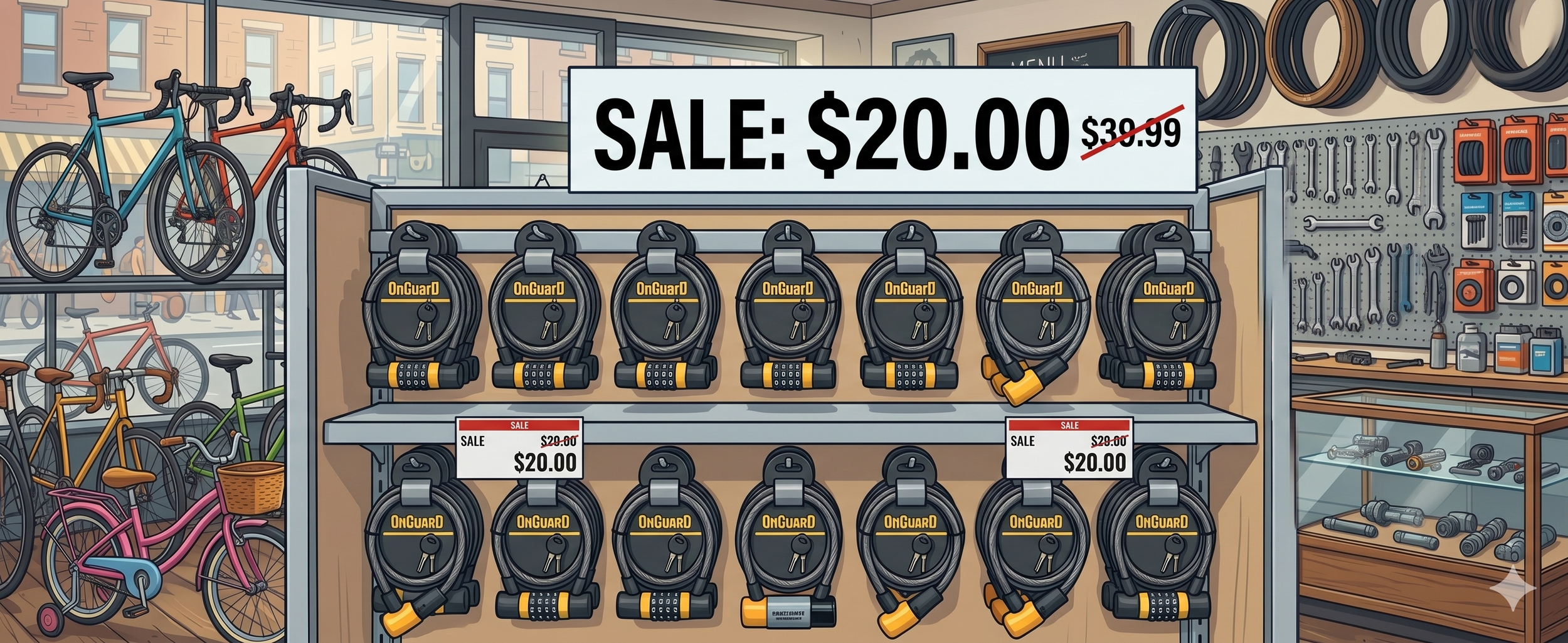
Either way, here's a conservative look at the labor on 20 locks:
Ordering, receiving, tagging: 15 min
Merchandising: 10 min
Promo setup: 15 min
Markdown and re-ticketing: 8 min
Photography?: 22 min
Packing and shipping 20 units: 30 min
Total: roughly 1.75 hours at $18/hour = $31.50
You spent $400. You recovered $400. You spent $31.50 getting there. That $31.50 isn't just a labor cost. It's the profit from two locks sold at full price, gone. And the other $400 in margin you would have made selling them right? Also gone.
You didn't break even. You went backwards.
Now think about the bike story. Same sequence, except the numbers are bigger, the labor is heavier, there's assembly time, boxing time, and freight on top of it. Run that math yourself.
Bad buying decisions don't show up at the register. They show up on your website. Six units of last year's model you took in February because the dating terms looked good and the bill wasn't due yet — that's not an inventory problem. That's a buying problem. You'd have been better off not ordering anything at all.
By the time a product hits your site at cost, you've already lost. The website didn't fail you. The buying decision did — before the order was ever placed. Liquidating online doesn't recover margin — it recovers floor space. Those are not the same thing.
And if your answer to "what does your website do for your business?" is "it's a good place to move slow inventory" — you're already losing. That's not an ecommerce strategy. That's where bad buying decisions go to die.
If selling online was always the plan, that plan needed to start before you wrote the PO.
How much of your margin are you losing on inventory you never planned to discount? Schedule a call. [link]