
The Phone Call Was the Last Chance — And Nobody Answered It
Part 2 of a series on the broken path between buyer and bike.
by Chad Pickard
Last week I documented (Part 1) what happens when a motivated buyer tries to find a $10,000 Enduro bike through a brand's dealer locator. Nine authorized dealers. Two had an actual bike catalog on their website. Seven dead ends.
I was looking for one specific bike. But the path would have been identical for nearly every model this brand makes. The $10,000 bike just made the failure impossible to ignore.
After I published that, I did what the websites told me to do.
I called.
I called both stores that actually had a bike catalog on their website. The ones that gave me something to work with online. The ones I gave credit to for having inventory visible and a functional path to purchase. I called them as a buyer — not a consultant. I had a specific bike, a specific model, and a credit card.
Here's what happened.
Call One
One bike in stock. Been there since 2021. The sales person wasn't sure he could order the model I wanted. He wasn't even sure they were still an authorized dealer for the brand. The whole call was uncertainty stacked on uncertainty. He searched online and suggested a big box outdoor retailer, a major online marketplace, and a direct competitor. He offered to build the bike if I ever found one somewhere else.
He never asked my size.
Call Two
This one started well. He engaged immediately. He asked questions. I thought I was going to get somewhere — and I would have been satisfied with a straight answer, even if that answer was that the bike was out of stock at the vendor. That's useful. That's honest. I can work with that.
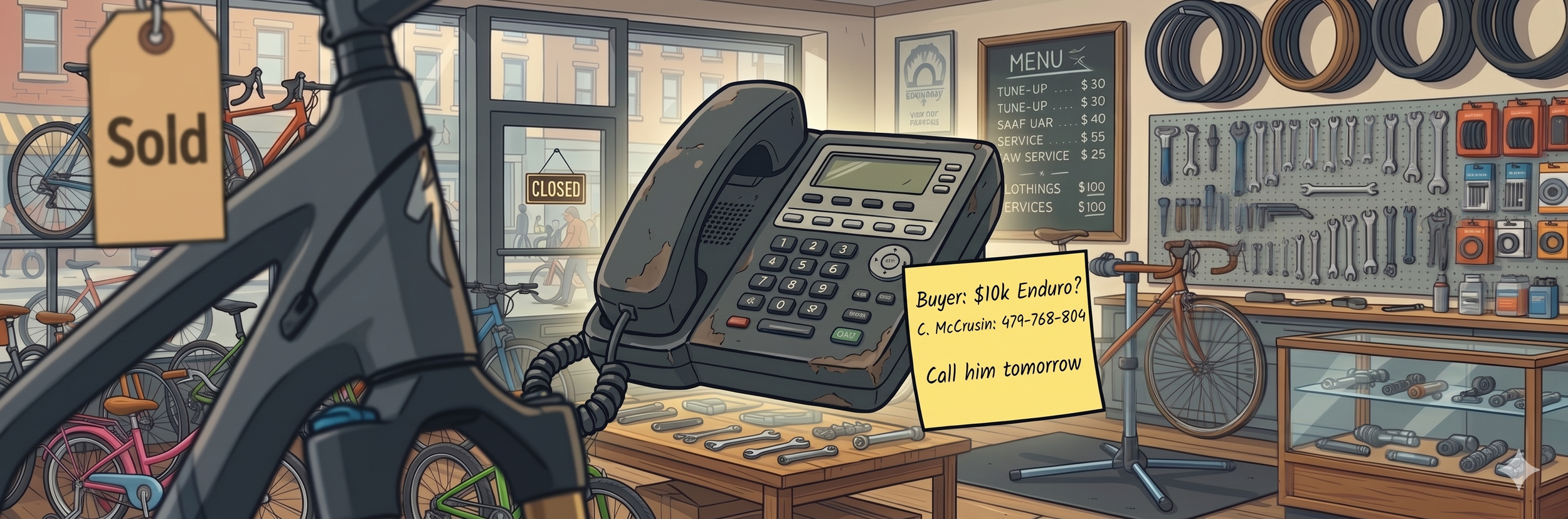
Instead, it went sideways. He couldn't check availability himself and handed the work off to someone else. He took my name and number and said he'd call back the next day.
He never asked my size either.
That was days ago. They haven't called back.
The urgency is gone.
Keep in mind — these were the two stores that passed. These were the ones with a functional website, visible inventory, and a path to contact. This was their first impression as a business. Not a bad day. Not an off moment. A first impression with a buyer who already had their credit card out.
First impressions in retail used to happen at the front door. Now they happen online. These two stores cleared that bar. The phone call was the moment to confirm what the website promised.
It didn't.
Here's what I want you to sit with for a moment.
That buyer — me, in this case — cleared every hurdle. Hit the dead end online. Didn't leave. Called anyway. Gave a name, a number, a specific model, and said I'm about 90% sure what I want. That is the highest-intent buyer who will ever contact your store. The brand already did the heavy lifting. They sold their product to the customer before the customer ever picked up the phone. All that's left is execution.
And the sale died on a sticky note next to someone's register.
The question nobody in this industry wants to answer:
Should a $10,000 sale depend on whether the manager is in that day?
Because that's what "I'll call you back tomorrow" means. It means the person who answered the phone didn't know how to look up availability, didn't know the ordering process, didn't know how to take a deposit, and didn't have the authority or the training to close it. So they bought time.
Time is exactly what a high-intent buyer doesn't have to spare.
This isn't about blaming the person who answered the phone. They did what they knew how to do. This is about whether your shop has a process for this specific situation — a buyer calling for a specific high-ticket bike that may or may not be in stock — and whether every person on your floor knows how to execute it.
If the answer is no, you don't have a staffing problem. You have a systems problem.
What that call should have looked like:
What size are you riding?
Let me check availability right now while I have you on the phone.
Here's what I can get, here's how long it takes, and here's what it costs to hold it.
Can I take a deposit today to lock it in?
Four steps. Five minutes. One sale.
Instead: a redirect to a competitor and a callback that never came.
Making Sure Your Inventory Makes It to Your Website
The phone call failure and the website failure share the same root cause: nobody owns the customer journey end to end. Here is what fixing it actually looks like — for both retailers and vendors.
Retailers:
Use a website platform that connects directly to your POS and pulls live inventory automatically. The technology exists and it works. The decision to use it is yours.
Never create a new product in your POS without complete information. Every item needs a UPC, SKU, size, color, make, model, a complete description, cost, and retail price entered correctly at the time of creation. Improvised product numbers and partial data are what break the sync between your POS and your website. If it goes in dirty, it comes out broken. This is non-negotiable.
Always create purchase orders in your POS first — not on the vendor's website. When shops order from a vendor portal and import the order later, it typically doesn't make it into the POS until the product physically arrives. That means nobody in your business knows what's coming, pricing isn't set, and product data is inherited from the vendor's system instead of yours. Build the PO in your POS first. You control the pricing, the data, and the timeline. No surprises.
Audit your website quarterly. Click through every brand page the way a customer would. If you can't find a bike in three clicks, neither can they.
Be deliberate about what goes on your website. Your site should show what you sell, what's coming in, and what customers are already asking for. Loading your site with everything you can theoretically order creates confusion — not confidence. If something isn't in your physical inventory, say so clearly. And if it says In Warehouse — whose warehouse is it? Yours, where you have control? Or the vendor's, or a 3PL (third party logistics) you have no influence over? That distinction matters to the customer. Be transparent about it.
Think carefully before building your own catalog content from scratch. If you spend ten hours creating product listings — photos, descriptions, specs — and you should be doing $1,000 worth of labor in that time, you may have been better off paying for a platform that provides that content as part of the service. Put a number on your time before you decide to do it yourself.
Train every person on your floor to navigate your own website. If your staff can't find inventory on your site, your customer can't either. Extra credit: take every customer to your website while they're standing in your store. Show them where to find the bike they want to buy. If they can find it with you, they can find it from home — and they'll come back knowing exactly where to look.
Assign ownership of product data to one person. It doesn't need to be a full time job. It needs to be someone's job. Data that belongs to everyone gets maintained by no one.
Vendors:
Do not gatekeep your dealer locator. Setting requirements that restrict which dealers appear in your locator doesn't protect your brand — it reduces visibility for the end user. Every missing dealer is a missing option for a buyer who is already looking. Make the locator as complete and accurate as possible.
Make web-ready assets available the moment a product hits a price sheet — not at launch, not at ship date, at introduction. Images, specs, geometry charts, color names, accurate hex codes. All of it. Retailers and platform providers need this information to do their job. Make it easy to get.
Sign up for the content distribution services that web platform providers offer. Workstand, Citrus Lime, and others have programs that push your product data directly to retailer websites. This is one of the highest-leverage things a brand can do to increase the visibility of their inventory at retail. If you are not enrolled, your product is harder to find than your competitor's.
Maintain a live digital asset library. Product data should be 100% accurate and available at all times. When a retailer has to call their rep to get a UPC or track down a spec sheet, that's friction that ends with dirty data in a POS — and a bike that never makes it to a website.
Audit your own dealer locator at minimum once a year. Click every link. If a store is closed, remove it. If a store has no website, flag it. A dead listing on your locator is your brand's dead end — not theirs.
Build digital readiness into your dealer agreements. A functional website with live inventory should be a condition of authorized dealer status. Not a suggestion. A requirement. You built the locator. You send the customer there. What they find when they arrive reflects on your brand.
Be proactive. The brands winning at independent retail right now are not waiting for their dealers to figure out e-commerce. They are actively recruiting dealers onto platforms that support live inventory, providing assets at product introduction, and making it easy for a retailer to show their product correctly and immediately. If your product can't be found on a dealer's website, it's not just the dealer losing the sale. It's your brand losing the customer — permanently, to someone who made it easier to buy.
The buyer who hits a dead end online and calls anyway is your highest-intent customer. They cleared every hurdle. They did the work. They are standing at your door with a credit card.
What greets them on the other end of that call — whether it's someone who can pull up live inventory, quote a lead time, and take a deposit, or someone who promises a callback that never comes — is a direct reflection of whether your operation is built to sell.
The shops and brands winning right now have made that choice deliberately. Clean data. Live inventory. Trained staff. A process every person on the floor can execute without a manager in the building.
That's not complicated. It's just not accidental.
If you want to know where your customer journey breaks down — and what it's costing you — [Schedule a Call.]
Update: The retailer that was going to call back DID get back to me. The bike I was looking for is out of stock and I could order it but it would be a month before it would ship. I asked for other options and none were offered.