
We Fixed Your Rate. Now Let's Pour Gas On It.
By Chad Pickard
In the last piece, we looked at what your labor rate is actually returning after wages and overhead — and why raising it is the most direct path to a profitable service department. If you haven't read it, start there. The math will change how you see everything that follows.
Because once the rate is right, the next question becomes: is your operation built to capture it?
Consistency isn't just a quality issue. It's a revenue issue.
Your best tech cares. You know this because you watch them work — thorough, methodical, nothing missed.
The problem is that nobody defined what the standard was supposed to be. So they invented their own. And somewhere on the same floor, another tech invented a different one. Same service. Same price. Two completely different outcomes — and your customers are the ones absorbing the variation.
That inconsistency has a cost. It shows up in customer trust. It shows up in ticket integrity. And it shows up in your best tech quietly donating expertise on every job they over-deliver without capturing the time.
The shops that solve this don't do it by working harder. They do it by getting intentional about what each service actually includes — and making sure everyone in the building is working from the same definition.
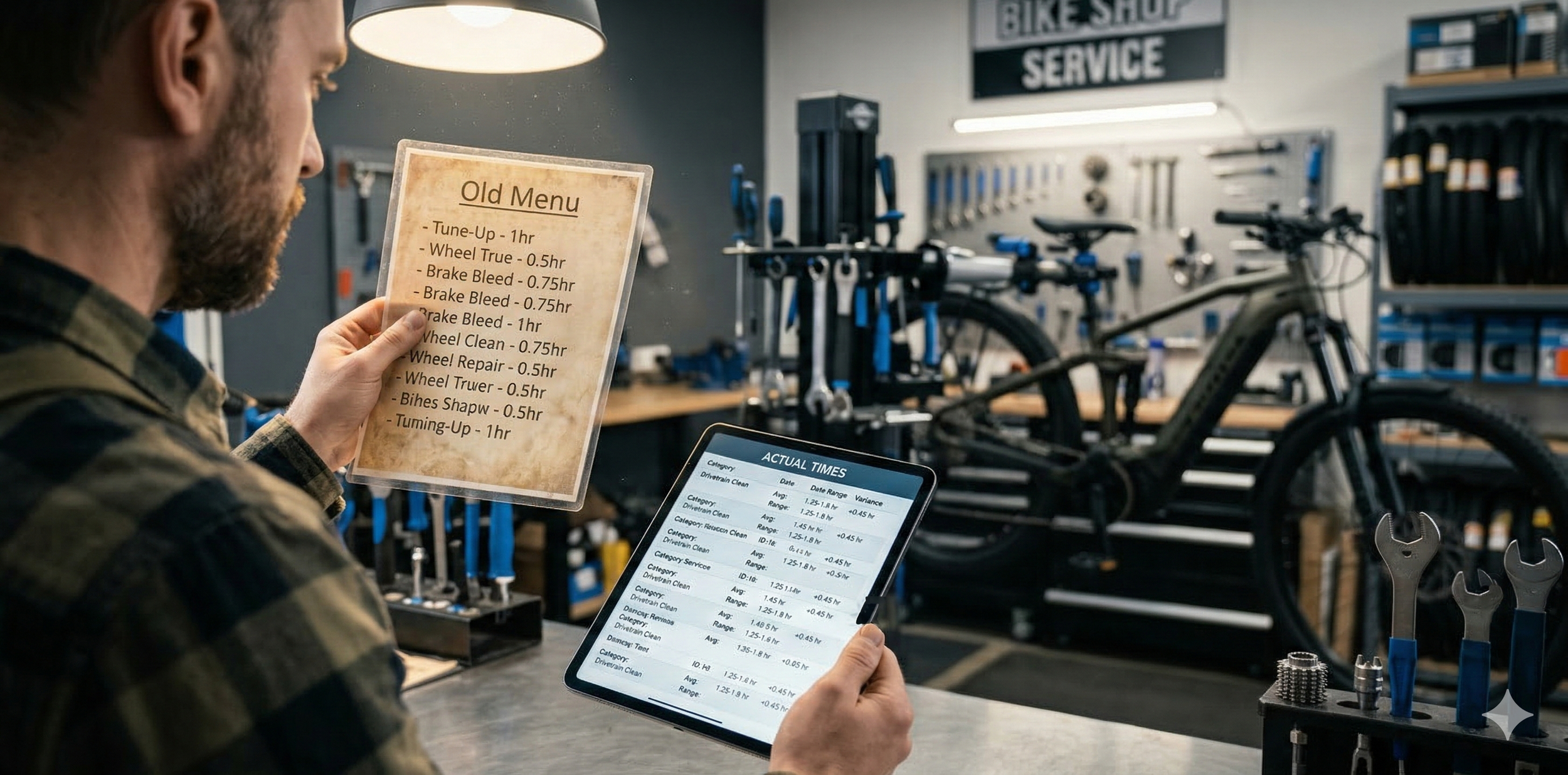
Your tune-up menu is telling a different story than you think.
When was the last time you looked at your service menu critically — not as a price list, but as a set of promises your team has to keep?
Most shops find, when they look closely, that scope and price drifted apart somewhere along the way. Services that made sense at one rate don't hold up at another. Time standards that were never written down got interpreted differently by every tech who came through the door.
That gap between what's on the menu and what actually happens on the floor is where margin disappears — quietly, ticket by ticket, without ever showing up as a single identifiable problem.
There's real money in closing that gap. But finding it requires a different kind of look than most owners and service managers take on their own.
Your service writer is either your biggest profit protector or your biggest leak.
Most shops think of service writing as intake — get the bike, write the ticket, hand it off.
The best shops know it's something else entirely. A skilled service writer isn't just documenting today's problem. They're building a plan for the customer's entire season — understanding where they're riding, what's coming up, what this bike needs to perform when it matters. They're setting expectations that protect the tech, protect the customer relationship, and protect the ticket from rework, missed charges, and misunderstandings that erode margin long after the bike leaves the floor.
That's not a skill most people come with. It's a skill that gets developed — or it doesn't, and the department pays for the gap every day.
Here's what it's all worth when the system actually works.
In the last piece, the math showed you what a rate increase does to your margin. But the rate is only one lever.
The other lever is efficiency — specifically, how much of your techs' time is actually making it onto a ticket. Most shops are billing around 50% of available labor hours. The ones with defined services, consistent execution, and strong service writing push that number to 75% or higher.
The difference between 50% and 75% efficiency at a $100 rate isn't incremental. It's the distance between a department that survives and one that drives the health of your entire business.
That number doesn't move by accident. It moves when the right systems are in place — and when someone who's done it before helps you see exactly where your version of those systems needs work.
You're closer than you think.
The shops that get here aren't exceptional. They're intentional. They took what was already working and added structure where it was missing.
If you're ready to look honestly at where your department is leaking — and build something that holds — that's the conversation I’m looking forward to.
Figures sourced from NBDA Cost of Doing Business Report and ZipRecruiter national averages, 2025–2026.