
The Bike "Pencils Out" Just Fine: A Rebuttal to the Industry Skeptics
by Chad Pickard
I recently read a column by Marc Sani in Bicycle Retailer. I don’t follow Marc’s every move, but I know he’s done good work over the years, and I truly appreciate the veteran perspective he brings to our industry.
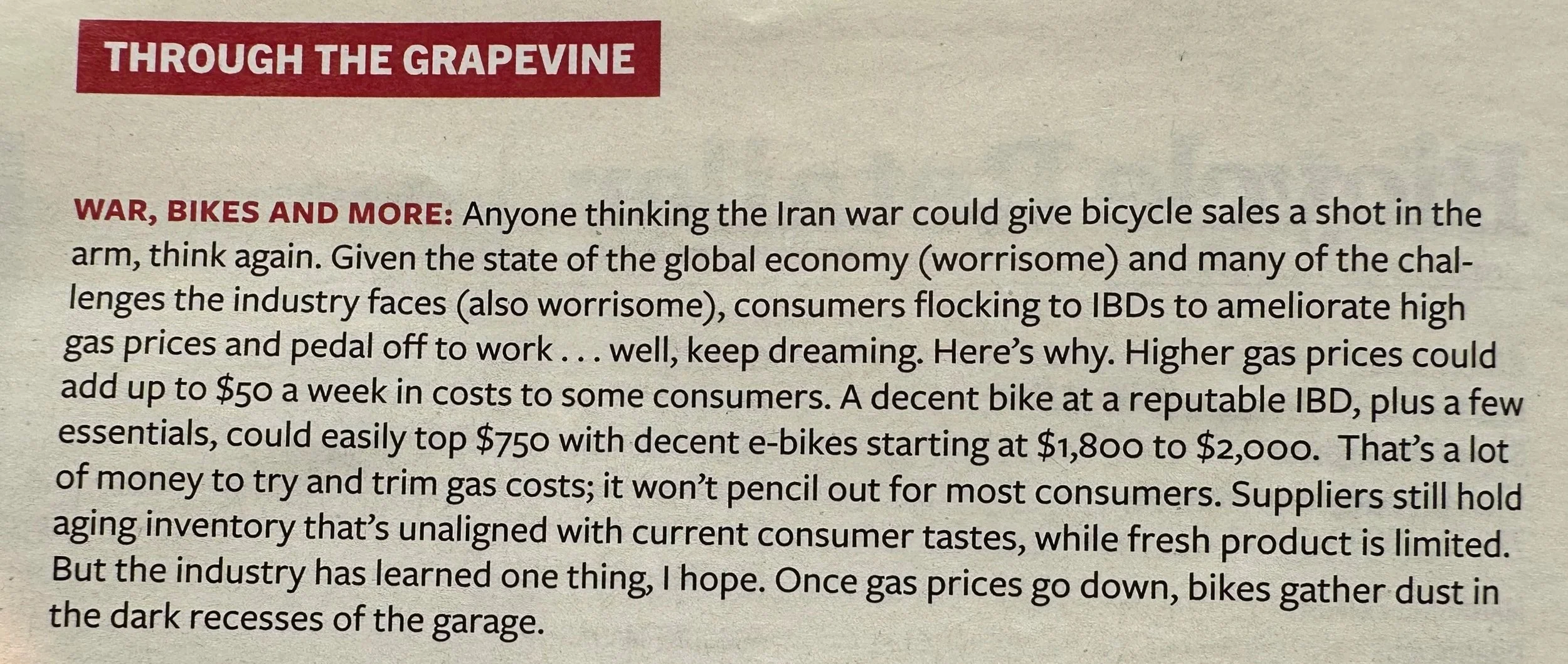
But Marc, I have to be honest: your latest piece in "Through the Grapevine" hit a bit of a sour note for me. In the column, Marc looks at the state of the world—the economy, the inventory, the price of entry—and essentially tells consumers "keep dreaming" if they think a bike is a viable solution. He writes:
"A decent bike at a reputable IBD... could easily top $750 with decent e-bikes starting at $1,800 to $2,000. That’s a lot of money to try and trim gas costs; it won’t pencil out for most consumers... bikes gather dust in the dark recesses of the garage."
Marc, I Get It.
I hear you. It’s exhausting to look at the headlines. Between the lingering shadow of tariffs, the "Amazon effect," and the rise of DTC giants, it feels like we’re constantly bracing for the next hit. When you’re staring at a screen full of economic data, it’s easy to see "dusty garages" instead of the open road. I can almost hear Marc reminiscing about a time when a full-squish enduro rig cost a nickel.
But to quote Abraham Lincoln: "The best way to predict your future is to create it." If we predict a future where the bike is a failed "pencil out" experiment, that’s what we’ll get. I want to create a different future.
Hammer 1: The "Multi-Car" Killer
Marc, you mentioned the $2,000 price tag as a barrier. But what are we comparing it to? No—we are competing with the Second, Third, and even Fourth Car in the driveway.
As of 2026, the average cost to own and operate a new vehicle has climbed to over $12,000 per year (AAA, 2025). Between surging insurance premiums and maintenance, that "extra" car is a massive weight on the family budget. If a family sells that 3rd or 4th car and buys two high-end e-bikes, they haven't "spent" $4,000. They’ve banked $8,000 in year one alone. That is a massive economic win that "pencils out" better than almost any other household change.
The "Staycation" Dividend: Why Regional Wins
While critics worry about the price of a bike, have they checked the price of a flight lately? The average cost of a one-week family vacation in 2026 is now hovering around $7,500. Airfare is up, and a mid-range hotel is a budget-buster.
When you factor in the stress of TSA and the sheer cost of being "away," the regional vacation isn't just a budget choice; it’s a sanity choice. A $2,000 bike is a one-time investment that turns every Saturday into a vacation. It offers a five-year "season pass" to adventure that doesn't require a boarding pass, a $30 airport sandwich, or an $8 "coffee-shaped thing."
Hammer 2: The Universal "Brain Boost"
Parents, turn down Jeopardy for a second. Think about the "Cognitive Dividend" for your whole house.
For the Kids: Research shows that biking to school increases concentration levels for up to four hours into the school day. You aren’t just saving gas; you’re sending your kid to class with a brain that is "turned on."
For the Adults: This isn't just for the kids. Even 20 minutes of cycling reduces stress hormones and boosts BDNF—"Miracle-Gro" for your brain cells. Whether you’re 8 or 48, you arrive at your destination smarter, calmer, and more focused than if you had sat in traffic.
Hammer 3: "Service is the New Bike Sale"
We need to stop telling people the "entry fee" is $2,000. "Run what you brung." There are thousands of bikes in garages right now that just need a pump and some lube. That $2,000 bike Sani mentions? That’s the bike they dream about. But the bike they need is likely already hanging in their shed waiting for a tune-up.
Retailers, here is your "Real Talk" moment: Marc mentioned that maintenance is becoming a barrier. Don't fear that—embrace it. Complexity is your opportunity. It is time to get your service departments profitable. Service is the new bike sale. Stop treating your mechanics as a "necessary evil" and start treating them as the reliability partners your community needs.
Be the Catalyst
Retailers, you don't have to do all the work—you just need to be the catalyst. Get involved with your city councils and help plan the infrastructure. Join the bike clubs. Work with All Kids Bike, Pedal Kids USA, or Project Bike Tech. When we build the riders, the market follows.
Where I live, we have the resources right here; in a city like Sioux Falls, we have the Big Sioux River Greenway—a 29-mile paved loop with only two stop signs and zero traffic—and 15 miles of single track in three city parks. Use these as your showroom. We are not an anomolie, we are becoming the norm for mid sized cities.
The Parenting "Pencil Out"
Maybe it’s time to pass the torch. Sell that old USPS-edition road bike sitting in the rafters and invest that money so your kids can be the warriors. Do you really enjoy the 90-minute gauntlet of the school pick-up line? Personally, I’d rather transfer through the Atlanta airport during a summer storm than deal with that gridlock twice a day. When your kids ride to baseball or soccer, you aren't just saving fuel—you are regaining your time and teaching them "Traffic IQ" that will one day make them safer drivers.
A Final Thought for Marc
Marc, I appreciate the work you’ve done. But put down the Kindle for an hour. Go out for a ride. Remind yourself what it feels like to have the wind in your face and the world’s problems disappear behind you.
We sell joy. Let’s stop telling the masses why it’s hard, and start showing them how great it is.
The future is what we make of it. Let’s make it a ride…..or maybe 32” wheels will save us.