
Your craziest idea for 2027 might just be unfinished
This one is going to take the long way around. Hang on through the trip down memory lane, because it ends up in your shop. Or your restaurant, or your hardware store, or whatever small business you’re running. The problem it solves isn’t specific to bikes.
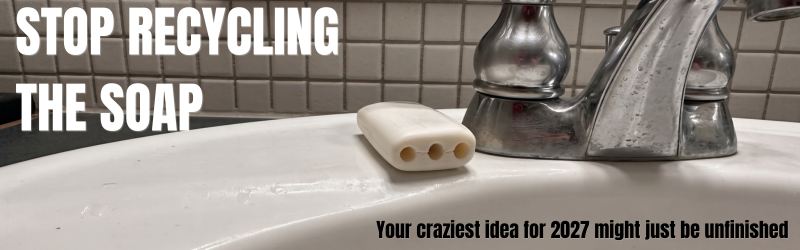
I stayed at an Airbnb recently and found this in the shower. Holey soap. Two holes molded straight through the bar. My first thought wasn’t about soap. It was about my grandpa.
I was blessed with an amazing grandpa. As parents, our job is to raise our kids the best we can. A grandparent’s job is to save those kids from their parents. Mine took it further and saved his great grandkids from their parent, which would be me. That has to be scientifically proven somewhere.
He lived within biking distance of our house, so I have a lot of stories. I don’t remember him ever working, though I know he did. He was a sheep buyer for the local meat packing plant, and they treated him well. He had a wood shop and built what he needed. He and my grandma traveled for fun. He also wrote children’s books and a book of poems.
I still picture his winter jacket. One jacket, the same one every winter, year after year. He didn’t need another one, so he didn’t buy another one.
His signature was a four-color retractable Bic pen. He drew jewelry on his granddaughters and watches on his grandsons. Rings, bracelets, a wristwatch with every number in place. You wore it until bath time and you were proud of it.
He was frugal and creative at the same time, which is a dangerous combination at a family potluck.
Our family had its share of long, boring get-togethers, and the boredom made us scheme. One afternoon we planned an entire heist on the parking attendant, the person who walks from meter to meter emptying the change. We worked out every detail. And the whole time we knew the punchline. Change is the worst thing you could possibly steal. It’s heavy. You’d haul a sack of coins down the street for an afternoon’s work and walk away with maybe $50. That was the joke, and we planned it anyway.
Another time, his frugality and his imagination collided over hotel soap. Hotels throw out an enormous amount of half-used soap. What if there were a soap deposit, refunded when you turned in your used bar? What if every leftover bar got shipped back to some factory in Ohio to be melted down and cleaned of whatever needed cleaning out of it? Use your own imagination on that part.
It was a ludicrous idea. Looking back, it wasn’t wrong. It was unfinished. We had the problem right. We just hadn’t found the version that worked.
Somebody else finished it.
They saw the same problem my grandpa and I were circling. Recycling wasn’t an option. Nobody is collecting half-used soap from 520 million hotel stays. So they thought differently. They looked at the bar and asked how much of it was actually doing anything. The guest still gets clean. The bar lathers, rinses, and fits in your hand like it always did. The soap they cut was soap nobody was using. Nobody misses the middle, and the guest gets to feel a little better about wasting less.
That sounds small until you run it across the country. Here’s some napkin math.
U.S. hotels fill about 3.56 million rooms a night. That’s roughly 1.3 billion room nights a year. At an average stay of 2.5 nights, that’s about 520 million stays, and 520 million bars of soap. At an ounce a bar, the industry goes through about 32.5 million pounds of soap a year.
Now say the holes take out 15% of each bar. That’s a guess, but run it anyway. About 4.9 million pounds of soap a year that never gets made. Roughly 120 truckloads that never ship. Over ten years, close to 50 million pounds.
And that’s the low number. It only counts one bar per hotel stay. Plenty of hotels put a second bar at the sink. Add every Airbnb and vacation rental. Same holes, same savings, many more bars.
Here’s the part I like best. My bet is the hotel pays the same for that bar as it always did. The soap just costs less to make. Less raw material, less production time, lighter cases on the truck, less weight in the landfill at the end. Maybe it even dries faster with all that extra surface. I have no idea. That’s kind of the point. When you change the thing itself, you find savings you weren’t even looking for. Same price, lower cost. That difference doesn’t disappear. It becomes margin for whoever made the bar.
For a single 150-room hotel, the soap saved is about 130 pounds a year. Nobody at that hotel would ever notice. That’s what makes it work. The idea only had to be right once, and then it repeats hundreds of millions of times.
Here’s where this lands for us.
A shop owner I talked with had a problem with product fading in the front windows. The team had good ideas. Rotate the window displays more often. Put up shades. Only put products in the window that hold their color. All reasonable. All of them were recycling soap.
The holey soap question was different: why is product sitting in the window long enough to fade? Turn the inventory faster and fading stops being a problem. So does the cash tied up in product that isn’t moving. Nobody in the room was thinking about inventory turns, because everybody was solving for the sun.
Every business has friction it has stopped seeing. The bikes still on the floor in October that get marked down 20%. The service backlog every April. The back room full of accessories nobody asked for. The customer who calls three times to ask if their bike is ready. Each one costs a little. Like the soap, a little repeated all year turns into a lot. We build routines around cleaning them up, and the cleanup works well enough that we never ask the crazy question. I did plenty of cleanup at my old shop.
Holey soap didn’t come from someone managing the leftover soap better. It came from someone willing to ask a question that sounded ridiculous out loud, and then keep working on it until it wasn’t. My grandpa would have loved it, mostly because it looked like a scheme that got away with it.

I know how hard it is to own a bike store. I want to share what I learned from 30 years working in the bike industry.
Bring whatever numbers you have.
There’s a line credited to Jessie Potter from the early 1980s: if you always do what you’ve always done, you’ll always get what you’ve always gotten. 2027 will look a lot like 2026 unless something changes about the problems 2026 handed you.
Whether your pre-season orders are signed or still on your desk, your 2027 plan isn’t finished. Most plans start with what we want more of. More sales, more service hours, more margin. Start with what you want less of.
And don’t do it alone. The people working your counter and your repair stand see friction you walked past years ago. Some of the best crazy ideas in your business are sitting in their heads, waiting for someone to ask.
What caused the most friction in your shop this year?
What would it be worth to never deal with it again?
What’s the crazy fix nobody has said out loud yet?
Sit down with your staff and list the five problems that cost the most time or money in 2026.
Pick the one that would change the most if it went away.
Have everyone throw out the most ridiculous fix they can think of. Don’t throw any of them out for being ridiculous. The crazy idea is usually a great idea that isn’t finished yet.
Find the part that has legs and put it in the 2027 plan with an owner, a number, and a date.
Do it before the calendar flips to 2027. The problems will still be there in January either way. The only question is whether you planned for them.
If you want someone to scheme with, book 30 minutes. Bring the list.
Some things get passed down whether you plan it or not. The spoon trick made it three generations. So did the scheming. The way we’ve always run the shop doesn’t have to.