
Unpopular Opinion: The Customer Isn't the Problem. The Question Is.
Communication is a two-way street. When it breaks down, it's worth asking whether the message was actually built for the person receiving it.
Think about kindergarten teachers for a second. The great ones don't just talk at five-year-olds. They move fluidly between the language of a child, a parent, a principal, and a colleague — same message, different frame, every time. That's not a gift. That's a skill they built on purpose.
I spend time on Reddit reading what's actually happening inside shops and what customers are experiencing in the wild. The r/bikemechanics community is blunt, funny, and worth your time. There's real learning in there if you're willing to look past the frustration.
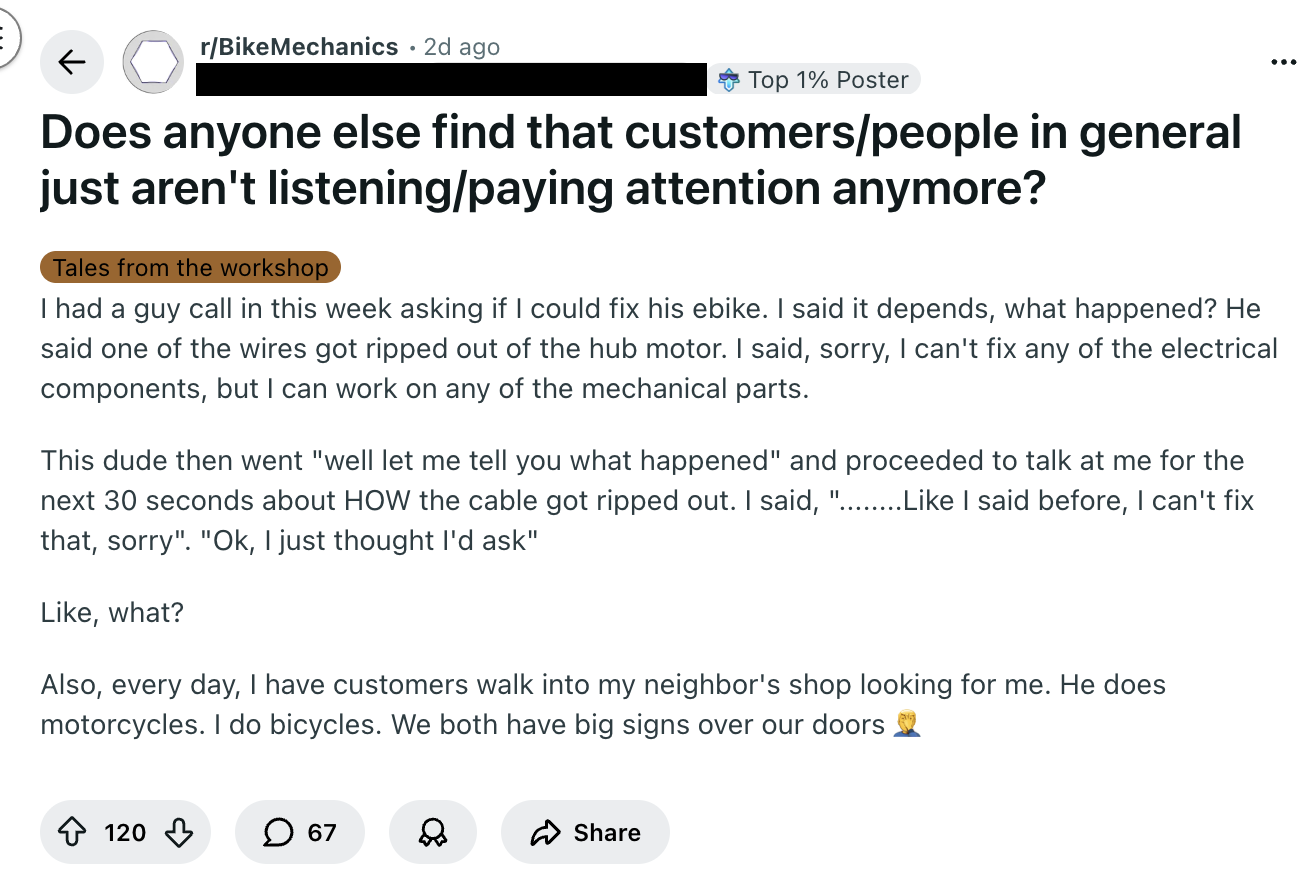
A recent post caught my attention. A customer called a shop asking about his ebike — a wire had been ripped from the hub motor. The mechanic said he only works on mechanical parts, not electrical. Reasonable answer. The customer then spent thirty seconds explaining how the wire got ripped out.
The mechanic was annoyed. The comments mostly agreed with him.
But a few didn't — and they're the ones worth reading.
One commenter pointed out something uncomfortable: when you say you only do mechanical things, not electrical things, the customer doesn't know how to distinguish them. That's not the customer being difficult. That's a knowledge gap the mechanic hasn't bridged yet.
Another figured the customer was trying to reframe the problem — hoping that if he explained it correctly, the mechanic would hear "mechanical" instead of "electrical." That's not stupidity. That's someone doing what all of us do when we don't speak the language: we try again, louder, with more detail.
A third commenter — a former bike mechanic who now owns a bookstore — watched a customer spend twenty minutes explaining the plot of War and Peace to him. His takeaway wasn't frustration. It was this: people just want to be heard, no matter what you do. The job was never just the repair. It was always also this.
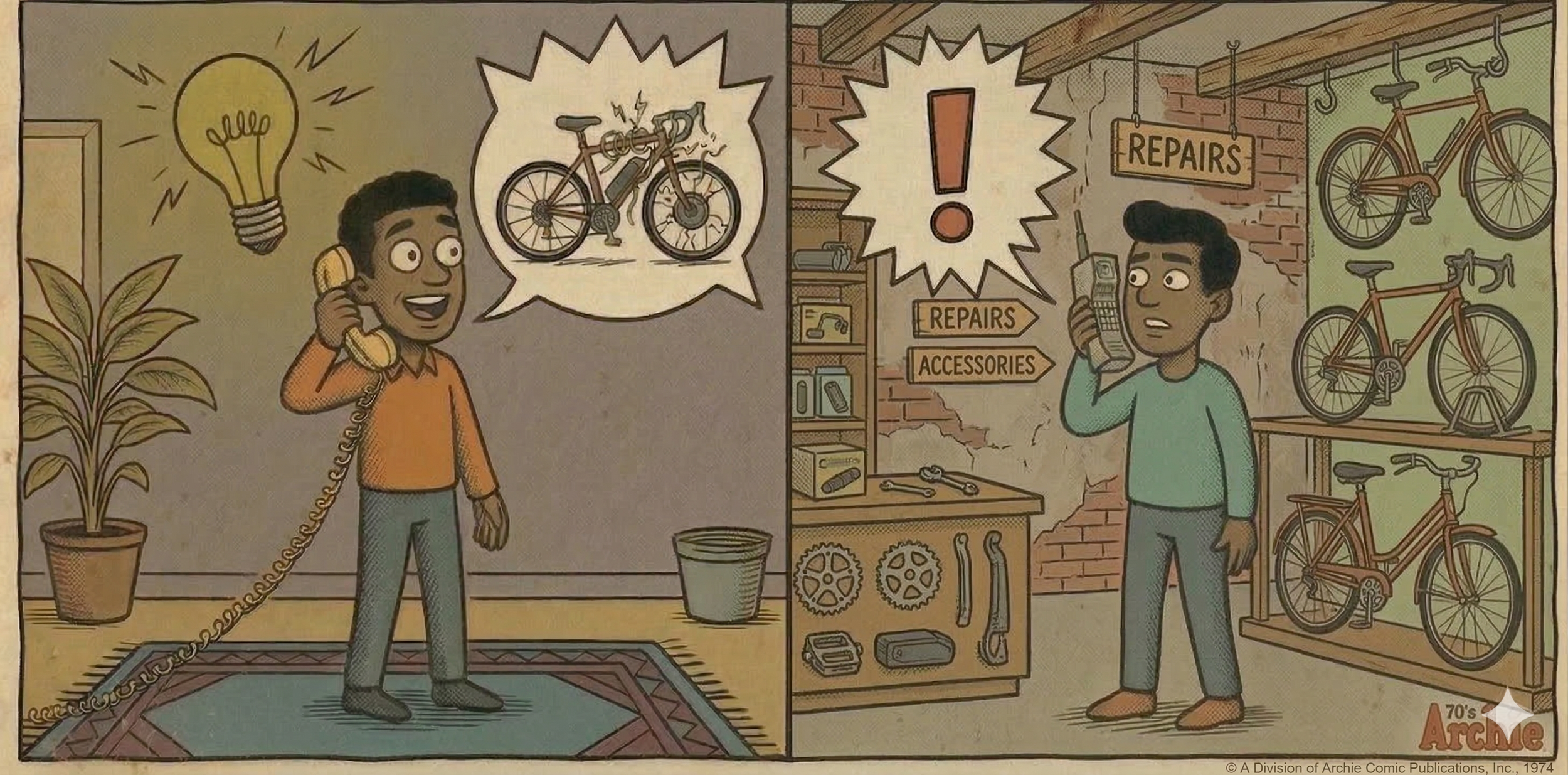
The same post included a second story. Every day, customers walk into the wrong shop — motorcycles instead of bicycles, bicycles instead of motorcycles. Big signs over both doors. Happens anyway.
If it happens once, that's the customer. If it happens every day, that's a communication problem — and it belongs to the shop, not the street.
One commenter offered the most useful reframe of the whole thread: we are bombarded with stimulus. Ads on fuel pumps, notifications on phones, signs on every storefront. By the time your customer reaches your door, they've already filtered out hundreds of messages that didn't apply to them. Your sign was number 301. That's not laziness. That's modern life.
You don't have to like it. But you do have to design around it.
A better line for the ebike call might have been: "The motor is basically the engine of your bike — that part I can't touch. But brakes, gears, frame work — that's all me." Same answer. Lands differently. The customer hangs up knowing exactly what you do, and maybe who to call next.
That's the work. Not just knowing the answer — knowing how to give it to someone who doesn't share your vocabulary.
The kindergarten teacher doesn't complain that five-year-olds don't understand adult concepts. She builds the bridge. Every time. That's the job.
So is this.
I read r/bikemechanics to stay close to what's happening on shop floors and what customers are actually experiencing. The community is candid, often funny, and full of real signal. Go spend an hour there. You'll learn something.
If you own a bike shop and you're still turning away ebike repairs — that's not a capacity problem, that's a revenue decision. Hub drive service is learnable, billable, and in demand. Reach out to Michael at Micro Mobility Connect and he'll walk you through it. I'll let him tell you how.
And if any of this hit close to home — friction at the counter, customers who don't listen, a service department that's leaving money on the table — reach out to me. That's exactly the kind of problem I work on. There's more potential in your service department than you think. Let's find it.