
Same Bikes. Different Name. New Problem.
You Already Know Something Is Wrong.
You can feel it. The floor doesn’t move the way it used to. The customers who do come in aren’t buying what you have. The vendor conversations have gotten harder. The bikes you actually need are either unavailable or arriving late, and the ones that did arrive are sitting.
You didn’t make all the decisions that got you here. But you’re the one living with them.
Here’s what’s actually happening — and who’s about to knock on your door because of it.
How the floor got stuck.
During COVID, demand outran supply. Prices went up. Some of that was legitimate — supply chains broke, shipping costs exploded, input costs rose. Understandable.
But when costs normalized, prices didn’t come back down. They became the new floor. A $300 bike in 1990 costs roughly $750 in today’s dollars. That’s where the accessible, functional, family-ready bike should still live. Legacy brands priced themselves above it and stayed there.
The customer who came in looking for a $500 bike and left without one isn’t gone. They’re just buying somewhere else or not buying at all.
And the margin built into that new floor? It didn’t come to your shop. You got allocation pressure and inventory risk. The brands got the check.
Their response to the hangover has been markdowns on high-end e-bikes. Dropping the price on the wrong bike doesn’t make it the right bike. It just reduces the bleeding on the wrong inventory.
Who’s at the door.
Chinese manufacturers — specifically XDS, the company behind X-Lab — are moving into the US market and they are targeting independent retailers directly. Not direct-to-consumer like Canyon. They’re hiring people out of Trek and Specialized, shipping from Los Angeles, and offering shop margins that your current vendors haven’t touched in years.
They have product your customer is asking for. At prices your customer will actually pay.
Before you decide what to do with that knock, it helps to understand who is actually standing there.
This isn’t the Honda story.
The easy version of this story is the Harley-Davidson parallel. Japanese bikes showed up cheaper and better, Harley got complacent, disruption happened. You know the story.
That’s not quite this.
When Honda came to the US they started from zero. No credibility, no relationships, no presence. They sold step-through Super Cubs to people who’d never owned a motorcycle, built trust slowly, and worked up from there.
XDS has been manufacturing for some of the biggest names in the Western bike industry for 31 years. Eight million bikes a year. They didn’t have to learn the product or earn access to the supply chain. They are the supply chain.
Honda had to knock on the door. XDS already had a key.
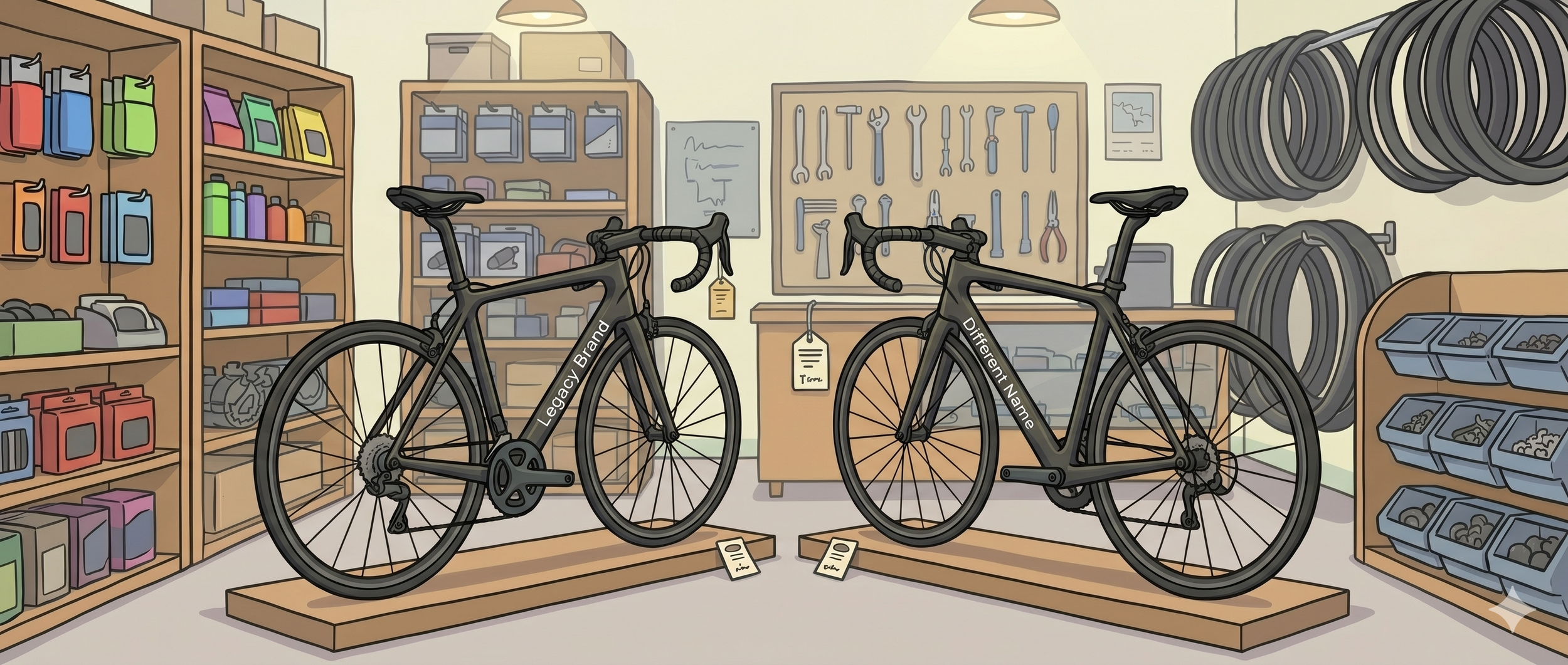
This isn’t a new competitor. This is your vendor’s factory with a different name on the door.
This playbook isn’t new.
Giant Bicycles ran it in the 1980s — OEM manufacturer puts their own name on the downtube, builds a dealer network, and becomes a top five global brand. I know this firsthand. I was a Giant retailer for over thirty years. The brand earned that loyalty. The difference today is that Giant’s success is exactly what limits them. They have legacy overhead, dealer agreements, and a margin structure to protect. They can’t cut to X-Lab prices without destroying the network they spent thirty years building. Giant proved the model works. They just can’t run it again without burning down what they built the first time.
And it’s not just bikes.
This isn’t a cycling story. It’s an everywhere story. CFMOTO spent years in a manufacturing partnership with KTM, absorbing European engineering standards and co-producing KTM models in China. Then they built their own motorcycle lineup, walked into US powersports dealerships at half the price of established brands, and watched North American sales climb 48% in 2025. In 2024 a CFMOTO took the Moto3 World Championship — the first constructors’ title for a Chinese manufacturer in Grand Prix racing. The powersports dealer having that conversation with a CFMOTO rep today is having the same conversation you’re about to have.
Chinese camera lens brands like Viltrox and 7Artisans entered the photography market at a fraction of Western brand prices and put comparable glass in the hands of photographers who couldn’t justify the legacy brand tax. The photography community went through the exact same cycle your customers are starting — dismissal, reluctant testing, forced acknowledgment that the product is genuinely good. Canon sent Viltrox a cease-and-desist. That’s not the move of a brand that isn’t worried.
The pattern is the same every time. A manufacturer reaches a point where the math of building someone else’s brand stops making sense. When that happens they don’t start small. They already know the product, the market, and the price point. The only thing that’s new is the name on the label.
Why now.
Not ambition. Math.
The Chinese domestic road bike market collapsed 70% this year. Western brands canceled manufacturing orders in 2022 and 2023 when their own inventory problems hit. XDS and manufacturers like them were left with capacity, tooling, and skilled labor with nothing to build.
They didn’t choose to come west. The math chose for them.
This isn’t a five-year strategic entry. This is a manufacturer with nothing to lose and full production capability moving as fast as logistics allow.
Don’t wait on an American solution.
It’s a reasonable thought. Tariffs are in play. The gap is real. Seems like an opening for domestic manufacturing.
The cost gap between US and Chinese manufacturing wages is real and structural. Tariffs make Chinese bikes more expensive. They don’t make American bikes cheaper. That’s not the same thing.
Guardian Bikes petitioned the White House for a 50% tariff on all imported bikes and frames. Not to make their product better — to make the competition more expensive. The broader industry sent 1,300 opposition comments. The White House denied it and eliminated the petition mechanism entirely.
XDS builds 8 million bikes a year. No domestic startup gets to those per-unit economics without decades of investment. The window opened faster than anyone can build a factory to fill it.
Where the market is splitting.
Premium at the top — Dura-Ace builds, WorldTour heritage, the buyer for whom price isn’t the deciding factor. Value at the bottom and middle — Shimano 105 and below, where Chinese manufacturers are building comparable product at half the price with better margins to the shop.
The brands caught in the middle — no clear heritage story, no price advantage, no defined identity — are the ones most exposed. A lot of the vendors your shop has been loyal to for a decade are sitting right there.
The way legacy brands and Chinese brands are spending tells you where this goes. Legacy brands are buying awareness — team sponsorships, glossy media, co-op programs that benefit the brand more than the shop. Chinese brands are buying trust at the point of sale — the sales rep in your shop is their marketing, and the YouTube reviewer with 200,000 subscribers is their ad campaign.
The retailer who figures out where they sit in that split before their vendor does is the one who controls the next conversation.
A note on mountain bikes.
The mountain bike category deserves a mention, because it’s moving differently than road and gravel. Chinese brands are entering MTB but they’re leading with eMTB, not acoustic full suspension. The reason is straightforward — geometry, suspension kinematics, and handling on a full suspension trail bike take years of iterative development to get right. A poorly spec’d road bike is disappointing. A poorly spec’d full suspension bike going downhill at speed is a liability. eMTB changes the equation because motors, batteries, and software play directly to Chinese manufacturers’ existing strengths in electronics and integration. Amflow — the house brand of DJI’s Avinox motor system — is the one shops are already feeling. The product is legitimate, the buzz is real, and it only officially entered the US market in July 2025. But here’s what’s worth noticing: Amflow’s market entry strategy is the opposite of X-Lab’s. X-Lab is leading with dealer margins to buy IBD loyalty. Amflow is leading with product demand — customers are finding the few authorized dealers that exist, not the other way around. The dealer isn’t the marketing. The product is the marketing. Two different Chinese brands, two different strategies, both taking share. The full suspension acoustic MTB gap is still there — but don’t assume it stays that way.
What to watch in the next three years.
Nobody knows exactly how this plays out. But there are three things worth paying attention to.
Your current vendors may consolidate or exit. The brands sitting in the middle of the K don’t all survive. The signal won’t be a press release — it’ll be a sales rep who stops returning calls, allocation that gets worse before anyone admits why, and minimum order requirements that don’t make sense for your volume. The retailer who sees that early enough to diversify their vendor mix controls the transition. The one who stays loyal until the announcement is holding unsupported inventory.
Chinese brands will hit a trust wall. The value proposition is real right now. But first warranty claims, first service issues, first parts availability problems at scale — that’s where IBD relationships get tested. A brand that supports the shop through those moments builds something durable. A brand that disappears when it gets hard confirms every skeptic. Watch how they behave when things go wrong, not when things are easy.
The $400 to $600 bike is the most important bike in your shop. That’s where the family purchase lives. The commuter who got priced out of the category. The lapsed rider coming back. Legacy brands have largely abandoned that range or are delivering compromised product because their cost structure won’t allow them to build something good there anymore. Chinese manufacturers aren’t just competitive at that price point — they’re dominant. The customer walking in with $500 in their pocket and a family to outfit isn’t looking for a heritage story. They’re looking for a bike. Right now your current vendor probably doesn’t have a good answer for them. Somebody will.
What to do with all of this.
The right answer isn’t the same for every shop. It depends on your specific vendor relationships, your current inventory position, and what your market is actually asking for. Those three things together tell you how exposed you are and how fast it matters.
If you want to work through it, you know where to find me. [let’s talk]